

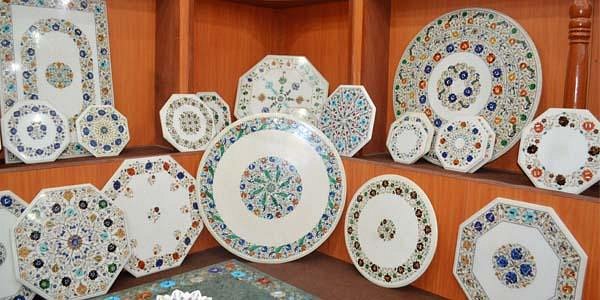
Marble handicrafts in Agra reflect India’s timeless art, tradition, and expert craftsmanship passed down through generations.
The narrow, bustling lanes of Agra produce a dominant sound that people hear as they walk through the streets. The sound comes from small workshops that artisans use to work on stone while they sit cross-legged.
Agra is not only famous for the Taj Mahal. The city serves as India's main entrance to marble handicraft production because artisans use traditional methods that have existed for centuries. Every marble plate, tabletop, jewellery box, or decorative artefact tells a story carved in stone—slowly, carefully, and by hand.
This is the real reason why marble handicrafts from Agra are treasured across the world.
The Mughal era established Agra as a worldwide artistic centre, which continues to define the city today. The city gained its reputation for exceptional marble craftsmanship when Emperor Shah Jahan ordered the construction of the Taj Mahal, which introduced Parchin Kari to India.
The famous handicrafts of Agra are not factory products. They are slow art—crafted with patience, precision, and heritage.
Today, the legacy continues through:
Family-run workshops
Traditional tools unchanged for generations
Skills passed from father to son
The marble handicrafts of Agra are direct descendants of Mughal artistry. The same technique that artisans used to decorate the Taj Mahal continues to be used by craftsmen in the city's artisan neighborhoods.
The extraordinary aspect of this situation comes from its lineage. Many craftsmen working today belong to families whose ancestors worked on Mughal monuments over 400 years ago. When you buy a marble artefact from Agra, you’re not just purchasing décor—you’re owning a piece of living history.
This is why the Agra marble emporium experience feels different from buying mass-produced décor elsewhere.
Not all marble is equal, and Agra’s finest handicrafts rely on Makrana marble, sourced from Rajasthan. This is the same marble used in the Taj Mahal, which is why authentic Agra marble handicrafts age gracefully instead of deteriorating.
Exceptional durability – among the oldest marbles in the world
Natural translucency – light softly passes through premium pieces
Non-porous surface – resists stains, yellowing, and moisture
The vibrant colors in Agra’s marble handicrafts come entirely from nature, not paint or chemicals.
Lapis Lazuli – deep blue from Afghanistan
Malachite – rich green from Africa
Carnelian – warm red and orange tones
Mother of Pearl – soft iridescence from the sea
These stones are chosen not just for color, but for durability and symbolism—making every piece timeless.
The Agra handicraft market offers a unique experience to people who walk through its entrance. The visit to an established Agra marble handicrafts manufacturer serves as a solution for people who want to experience authentic craftsmanship at fair market rates. The small workshops behind storefronts provide customers with a view of artisans who work there.
You’ll find:
Marble tabletops and coasters
Jewelry boxes and vases
Home décor and corporate gifts
Museum-quality replicas
Finding the best marble shop in Agra isn’t about flashy displays—it’s about craftsmanship and transparency. A trusted Agra marble emporium will happily explain materials, process, and care.
Light Test: Hold the marble against light; real Makrana marble glows softly
Touch Test: Inlay work should feel perfectly smooth
Price Reality: If it’s too cheap, it’s likely painted stone
You’re paying for craftsmanship, heritage, and permanence—not just decoration. Authentic marble handicrafts take:
Hundreds of man-hours
Skilled labor refined over decades
Rare natural materials
These artifacts aren’t meant to be trendy décor. They’re heirlooms—objects that age with grace and carry stories across generations.
In a world of fast design, Agra’s marble handicrafts remind us that beauty takes time.
Agra’s marble handicrafts represent the soul of Indian craftsmanship—where patience, heritage, and artistry come together in stone. The city streets and marble shops display Mughal heritage through all their products.
Whether you’re exploring the Agra handicraft market, searching for the best marble shop in Agra, or sourcing directly from a marble handicrafts manufacturer in Agra, remember this: you’re not buying an object—you’re preserving a legacy.
Marble handicrafts in Agra are famous for Parchin Kari (marble inlay work), made using Makrana marble and semi-precious stones with traditional Mughal techniques.
Agra is famous for its marble handicrafts because the art was introduced during the Mughal era and perfected during the construction of the Taj Mahal.
Most authentic Agra marble handicrafts are crafted from Makrana marble, renowned for its exceptional durability, translucency, and resistance to stains.
Check for light translucency, a smooth inlay surface, and realistic pricing. Genuine marble inlay work is never painted or uneven.
You can buy authentic marble handicrafts from reputed Agra marble emporiums, certified showrooms, or directly from trusted manufacturers in Agra.
Yes, authentic Agra marble handicrafts are completely handmade using traditional tools and techniques passed down through generations.
They are expensive due to high-quality Makrana marble, semi-precious stones, and the hundreds of hours of skilled manual labour involved.

Discover why foreign tourists in Agra prefer staying longer. Explore sunrise at the Taj, UNESCO site...
Read More
Plan a destination wedding in Agra with royal venues, timeless architecture, luxury stays, and a lov...
Read More
Agra is a city that lives in the shadow of the Taj Mahal — and rightly so. But while the white...
Read More